Single Split vs Multi-Split: Cooling More Than One Room
Multi split vs single split air conditioning explained: how each works, the pros and cons, and which suits cooling or heating more than one room.
By GreenAir Air Conditioning7 min read
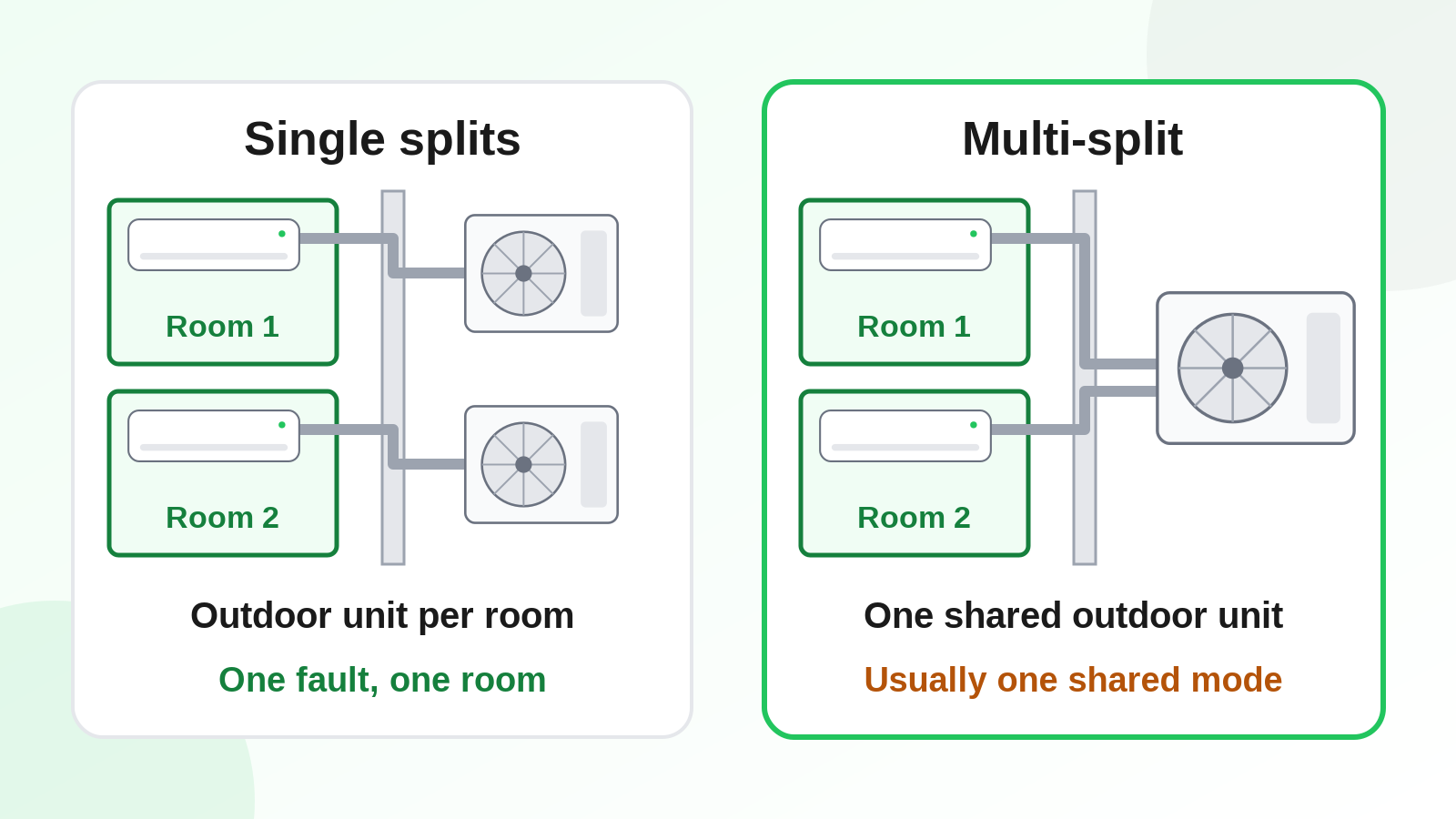
If you want air conditioning in more than one room, you have two main choices: a separate single split system for each room, or one multi-split system where several indoor units share one outdoor unit. Neither is better in every case. This guide explains how multi split vs single split systems compare, so you can tell which suits your home or business before you ask for a quote.
What is a single split system?
A single split is the simplest type of fixed air conditioning. It has:
- one indoor unit, usually mounted high on a wall, which blows cool or warm air into the room
- one outdoor unit, which holds the compressor (the pump that drives the cooling and heating) and gets rid of the heat
- insulated refrigerant pipes, a cable and a drain linking the two through a small hole in the wall
One indoor unit, one outdoor unit, one room. If you want three rooms done with single splits, you have three indoor units and three outdoor units.
What is a multi-split system?
A multi-split uses one outdoor unit connected to two or more indoor units, each in a different room. Each indoor unit has its own pipe run back to the shared outdoor unit, and each room usually has its own remote or controller, so you can set different temperatures and switch rooms on and off separately.
How many indoor units one outdoor unit can run depends on the model. Manufacturers also set limits on total pipe length, the height difference between units and which indoor units can be combined, so the system has to be designed as a whole rather than added to piece by piece.
Multi split vs single split at a glance
| Single splits (one per room) | Multi-split | |
|---|---|---|
| Outdoor units | One per room | One shared unit |
| Space outside | More wall or ground space needed | Less: a single, larger unit |
| If the outdoor unit fails | Only that room is affected | Every connected room is affected |
| Modes | Each room can heat or cool independently | Usually all rooms must heat or all cool |
| Pipe runs | Short, direct runs from each room | Longer runs back to one outdoor unit |
| Adding rooms later | Easy: add another single split | Only if the outdoor unit has spare capacity and connections |
| Efficiency | Each unit sized for one room | Can be less efficient when only one room is running on a large outdoor unit |
The advantages of a multi-split
Fewer outdoor units on the wall
This is the main reason people choose a multi-split. Three single splits mean three outdoor units, which can look cluttered and may simply not fit, especially on a terraced house, a small yard or a shop with a narrow rear wall. One outdoor unit is tidier and leaves more space.
One location to think about
With one outdoor unit, you only need to find one good spot: somewhere with enough clear space around it for air to flow, away from bedroom windows (yours and your neighbours'), and where an engineer can reach it for servicing.
Each room still has its own control
You do not lose independent control. Each indoor unit can be switched on and off and set to its own temperature, so you are not cooling an empty spare room just because the lounge is warm.
The drawbacks of a multi-split
All rooms usually share one mode
This catches people out. On most multi-split systems, the outdoor unit can only work in one direction at a time: it is either cooling or heating. Manufacturers' manuals for multi-split systems explain that if one room asks for heating while another asks for cooling, the system cannot do both, and one of the indoor units will wait in standby until the modes match. Which room wins depends on the model.
In a typical home this rarely matters, because rooms tend to want the same thing at the same time of year. It can matter if, for example, a sunny south-facing office wants cooling on a spring afternoon while a cold north-facing bedroom wants heating. If that sounds like your property, single splits may suit you better.
One fault affects every room
If the shared outdoor unit develops a fault, every room connected to it stops heating and cooling until it is repaired. With single splits, a problem with one system leaves the other rooms working. For a business that cannot be without cooling, such as a room with computer equipment, that resilience can be worth a lot.
Longer pipe runs
Each indoor unit needs its own pipes back to the outdoor unit. If the rooms are spread around the building, some runs can be long, and every run has to stay within the manufacturer's limits. A good installer will plan the pipe routes during the survey, so you know where the trunking will go and whether a multi-split is practical at all.
Less flexible to expand
A multi-split outdoor unit is chosen for a set number of rooms. If you think you might want another room done later, say so at the survey, so the outdoor unit can be chosen with that in mind. With single splits, adding a room later is just another installation.
Efficiency when only one room is on
A multi-split's outdoor unit is sized to handle all the connected rooms. If you often run just one small room, it may not work as efficiently as a single split sized exactly for that room. Modern inverter outdoor units, which slow the compressor down rather than switching on and off, help with this, but it is worth thinking about how you will actually use the rooms.
Which should you choose?
A multi-split often suits you if:
- you want two or more rooms done and space for outdoor units is tight
- the rooms are fairly close together, such as bedrooms on the same floor
- you want one neat outdoor unit rather than several
- your rooms tend to want heating or cooling at the same time
Single splits often suit you if:
- you only need one or two rooms and there is space for the outdoor units
- the rooms are at opposite ends of the building, making shared pipe runs long
- different rooms may need heating and cooling at the same time
- you cannot afford for every room to lose cooling at once, for example in a business
- you plan to add rooms one at a time over a few years
There is also a middle ground. Some properties end up with a multi-split for a group of rooms close together, plus a single split for a room that is used differently, such as a home office, a server cupboard or a garden room.
Getting the size right
Whichever you choose, each indoor unit needs to suit its room, and with a multi-split the outdoor unit needs to suit the combination of rooms. Our guide on what size air conditioner you need explains the basics, but a survey is the only way to get it right.
Permission and installation
Both types are fixed systems, so the pipe connections and commissioning must be done by engineers certified to work with F-gas refrigerants. The UK government explains the requirements for companies working on equipment containing F gas.
Outdoor units may also need permission. Permitted development rights in England cover many air source heat pump installations, but they come with limits and conditions, and they work differently for flats, listed buildings and some conservation areas. Check the Planning Portal guidance on air source heat pumps and speak to your local council if you are unsure. Business premises are treated differently from homes, so commercial installations are more likely to need a planning application. If you rent or live in a flat, you will also need consent from your landlord or freeholder.
Once installed, both types benefit from regular servicing. With a multi-split, keeping that shared outdoor unit in good order matters even more, because every room relies on it.
Ask for an honest recommendation
GreenAir installs both single split and multi-split systems in homes and businesses across Birmingham and the West Midlands. We will look at your rooms, where an outdoor unit could go and how you use the space, then tell you honestly which option makes sense. Find out more about our air conditioning installation service, see our recent work, or contact us for a free quote.